
Scripture audio studio
A book of the Bible, dramatized.
Give the studio the text and it produces the finished audio: every speaker cast in a voice of its own, delivery directed line by line — whispered, weeping, crying out — then scored with music, placed effects, mixed and mastered. Chapter after chapter, in languages the big platforms do not offer.
Text in, produced chapter out — and a mother-tongue listener signs off before anything ships.
From text to a produced chapter
Three stages, and a person — not a model — has the final word at each gate.
Bring the text
Load a book as USFM, or paste a chapter. The studio reads it as a script: it works out who speaks every line — the narrator, Jesus, the disciples, angels, unclean spirits, the crowd — and where the scene changes.
Cast, direct and score it
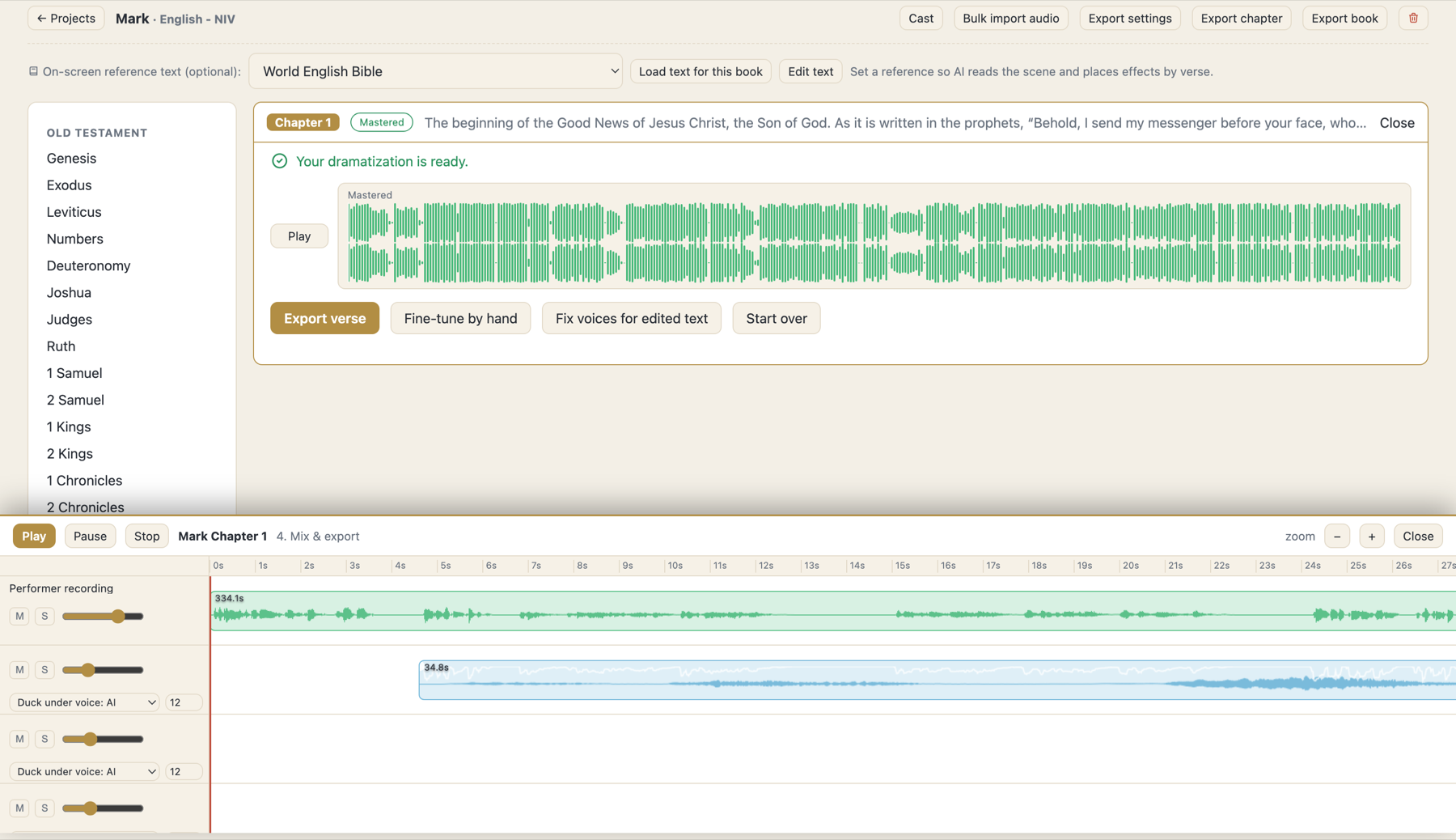
Each speaker is voiced from your approved cast, so an angel never sounds like the narrator. Delivery is directed line by line with stage directions written into the text — whispered, weeping, crying out — and music and effects are composed and placed under the Word, ducking beneath the voice rather than over it.
Review, master, deliver
A mother-tongue listener approves or corrects verse by verse; corrected verses are regenerated surgically, nothing else is touched. The chapter is mixed and mastered, and exports as WAV, FLAC or MP3 at the rate and depth your partner's toolchain wants.
You can hand the whole chapter to the studio, or take any stage by hand — the cast, a single line's delivery, the music, the mix.
What the dramatization actually does
Bring a Bible as USFM and the studio produces it end to end — a chapter, a whole book, or the whole Bible.
Every speaker, a voice of its own
The story engine reads each chapter and finds who speaks — the narrator, Jesus' disciples, angels, unclean spirits, the crowd — and each one is voiced from your approved cast, so an angel never sounds like the narrator.
Directed emotion, line by line
Delivery is directed with stage directions written into the line — whispered, weeping, crying out. The engine proposes them; a person can override any line by hand and regenerate just that line to audition it.
Scored like a production
Music and effects sit under the Word — style per project, levels per verse, effects word-synced where the text calls for them. The same mother-tongue review gates the result before anything ships.
Already have recordings? Convert the voices
When a reader has already performed the chapter, the studio recasts the voices and keeps the performance. Two facts govern that work, and Lexis says both out loud instead of hiding them.
Emotion is preserved, never generated
No model can edit the emotion of a real recording — and it doesn't need to. Your narrator provides the performance; conversion changes the voice identity and guarantees the performance survives. If a line needs different emotion, the reader records it again.
A voice carries its own accent
Converted speech pulls the target voice's accent into your language. Lexis warns before every conversion and offers trained native voices that structurally cannot change pronunciation — the accent-proof path for ethnic languages.
The rolled R test
On a trilled R — the sound accent damage kills first — our trained native voices kept 103–112% of the trill's strength. Standard voice conversion kept about 85%. That difference is why the native path exists.
One character, one voice
Every character converts with a fixed seed, so a character sounds like the same person in chapter 3 and chapter 40 — across hundreds of takes.
Built for the dubbing bench
Cast decisions live on a cast board seeded from the production's own casting guide. Conversion is a separate bench with per-file progress, instant A/B against the original, and settings that mirror the engine's own controls.
DAW-ready out of the box
Character folders, original filenames, mirrored formats, and an embedded conversion record in every file — drop the folder next to your session and relink.
Video dubbing and trained voices
The same studio dubs video and grows new voices — with the same honesty about what each step does.
Video dubbing that respects timing
Professional dubbing keeps the original rhythm; so does Lexis. Lines that run long or short are flagged — and can be rewritten to fit — rather than tempo-warped into unnatural speech. Only changed lines re-voice on the next pass.
Subtitles skip a whole stage
Bring an SRT or VTT file and transcription is skipped entirely — the dub starts from the words you already approved, with their timings.
Voice training per language
From recordings of a local speaker, Lexis trains a dedicated native voice for your language — the accent-proof voices in the pool were built exactly this way, and yours can be too.
Voice cloning, with consent
A real person's voice is cloned only with their signed release — the platform reminds you at the moment of cloning, not in fine print afterward.
One shared voice pool
Library voices, your clones, and your trained native voices live in one pool, filterable by language, age, and accent — cast once, reuse across projects.
Pronunciation rules that stick
Written-to-spoken rules fix how a name is said without touching the approved text — and only lines containing a changed word re-voice.
Built for the languages the platforms skip
Lexis is language-agnostic by design — nothing about a language or script is hardcoded. It runs today on minority languages across regions and scripts, with real projects behind each one.
Any language, first-class
Languages with no commercial voice support get trained native voices — from Mazandarani in Perso-Arabic script to Chuvash in Cyrillic. Bring a seed corpus or a few hours of native recordings, and the workflow treats the language as first-class from the first chapter.
Every script, both directions
Right-to-left and left-to-right layouts, Perso-Arabic, Cyrillic and Latin scripts, and an interface that ships in two languages with every screen mirrored — a second face of the studio, not a translated afterthought.
Offline-friendly review
Reviewers without reliable internet work from self-contained files and their decisions import back with conflict protection — built for the field, not the office.
Standing rules, enforced in code
The reader's performance is preserved, never fabricated — emotion in a real recording is kept, not synthesized. A voice carries its own accent, and Lexis says so before you convert. Files return in the format and under the names they arrived with. And nothing is published without mother-tongue approval — the native ear stays the final word.
Built for teams
Your recordings, your voices, your projects — with the walls in the right places.
Private by organization
Projects, cloned voices, and converted takes are visible only to your own organization — down to the raw file URLs. Another customer can never reach your recordings, even with a guessed link.
Access shaped per team
Each organization opens exactly the sections it needs — a dubbing crew can live entirely in its own workspace. Roles narrow further per member, down to a single project in a single language.
Per-language projects
One project per language version, each owning its cast and takes; the voice pool and the casting guide are shared, so a second language starts from a running start.